Sunday, May 1, 2016

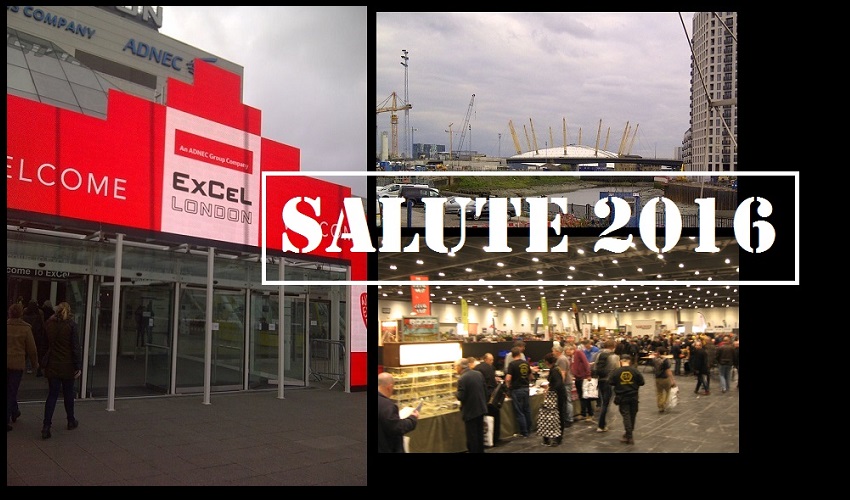
16th April, London, ExCel

SALUTE 2016


Salute 2016 was its usual grand day out: though slim pickings for the Ancient and Medieval enthusiast - the theme was Steam Punk although you wouldn't know it from all the Science Fiction which seemed the dominant genre.

Although I know they turned some others away, the only big ancients game I could see was our own 28mm Magnesia played as a Lost Battle.  That's quite an amazing degree of under-representation given how many enthusiasts tick 'ancients' on surveys and how big the ExCell hall is.

(Salute 2016: the Society of Ancients stand and - behind - Magnesia game)

So this won't be the same as the other Salute reports from this year - and half a dozen different views of the Star Trek bridge ... I'll showcase the few historical games from before 1500AD ...

Without the Society of Ancients and Lance & Longbow there would have been fewer.  Always worth remembering if you were under the impression that the Society's mission in championing the historical wargame was done already.

(Championing the historical wargame ... without these volunteers, what next?)

The Society of Ancients presented the great Roman triumph of Magnesia ...


(Salute 2016: the Lost Battle of Magnesia)

Presented by Prof. Phil Sabin and the shows team.


(Salute 2016: Magnesia 190BC by The Society of Ancients - detail)

This was an live game played 3 time with visitors to the show joining in.

The Lance & Longbow Society had Rob Broom presenting an anniversary refight of Hastings using his popular War and Conquest rules ... again played with show goers throughout the day ...


(Salute 2016: details from the battle of Hastings by The Lance & Longbow Society)

Not quite historical ... the Skirmish Wargames folk put on this attractive myth game in 54mm ..


... and reprising last year's theme, there was an impressive battle of Agincourt ...


I also liked this 28mm medieval encounter in Eastern Europe ...


Snow just works so well for games at shows ...


More Dark Age/Medieval from Dalauppror ...


... and some Saga ...


So, actually not too bad if you are at the Dark Age/Medieval part of the spectrum but just the one historical ancient battle.  Hmmm ...

Very little also for the naval enthusiast - and this year was the 100th anniversary of the battle of Jutland.   A surprising absence, perhaps?

Elsewhere ...


... there was lots of everything else ...

Especially, I liked ...


... the train ... and I liked ...


... the ships in the docks ... This was a huge decorative side table to the historical 'what if' ECW Bristol scenario - actually a rather splendid game ...

(Redoubt (sconce) in the ECW game 'What if Essex had gone to Bristol')

And I always like the Continental Wars Society and their mix of wargaming presentations prints and flats ...

(Salute 2016: the Continental Wars Society display)

(more Salute 2016)

... and there was some splendid miniature architecture on show ...

(overlooking the battle of Moncontour, 1569)

(Wilhelmstadt, beside the battle by Bill Gaskin and friends) 

Of course these, like the port at Bristol, are not really part of the battle, just decorative add-ons.  Now, as a modeller, I love to see them and they help make my Salute - but I do understand why some question their relevance (especially when the organisers are turning away core subject historical wargames) ...

So ... I really enjoyed Salute 2016 - I always do: a special blend of wargame magic with shopping, meeting old friends and enjoying the spectacle.  This year, the dearth of historical games was a disappointment, especially to the ancients enthusiast.

It was a grand day out but a missed opportunity.  I hope next year's show has a better balance of wargame types and interests.

Come see us at Campaign, by the way ...

Friday, April 29, 2016

Double DBA Pharsalus at the BattleDay


My contribution at the BattleDay was to stage Pharsalus using some DBA options including the Double DBA format I proposed for Zama back in 2011.

The scenario needs to compel the players to fight in depth ... giving them 2 DBA armies, one behind the other.  The first two should fight themselves to a standstill before being withdrawn.  The clash of the main/reserve armies that follows should be the one that counts.

I needed some more 10mm Romans for this, of course ...

(Pompey's cavalry ... some of the older Chariot Spanish, some Newline Hellenistics)

Many thanks to Newline Designs for excellent service (and some very nice 10mm figures)

(Newline Designs 10mm Marian/Caesarian Roman legionaries )

The figures, built on the Zama collection, are mounted on standard 40mm basewidths (just extra figures): I like the look - each base being a more convincing 'unit' in the smaller scale.

(the personalities ... drop in pieces to go on the command stands)

to cover the Big Battle options, I made up 8 commanders, each an individual to fill a magnetised gap on a general's element ...

(Mark Antony leading a cavalry envelopment ... a new command piece)

(Metellus Scipio commanded Pompey's centre at Pharsalus ... he was a great descendent of Scipio Africanus so I was able to recycle an existing figure for him)

Pompey in overall command of his army with Afranius, Ahenobarbus, Scipio and Labienus as generals ... Caesar commanding his army and taking charge of the Reserve and Right Wing ... with Calvinus and Mark Antony controlling the centre and left respectively ...

(following the traditional interpretation, I put a large camp behind Pompey's army,  but left Caesar's off table)

Although I had intended to play both the BB and Double DBA options, we focused attention solely on the latter - so while it was nice to see all the personalities and note their positions in the order of battle, we only needed 4: Calvinus commanding Caesar's opening phases, Labienus the Pompeians ... and Caesar and Pompey to command the decisive phase.

I used 72 elements, but due to the numerical disparities, split them 34 to Caesar, 38 to Pompey.  It would give Pompey a break point 2 higher.  One of the challenges of the day would be to see if this asymmetry would unduly distort DBA's underlying balance.

(Battle on the plains beside the river Enipeus at Pharsalus)

Actually we played the Double game twice with a win each to Pompey and Caesar ... not enough games to be remotely scientific but certainly a veneer of balance.

The basic idea with Double DBA is that the two armies deploy 2 commands each, one in front of the other, and rolling a pip die for each.  The front commands wear each other down hoping to break through and do some damage to the enemy's main force.  Both opening phase commands are withdrawn when exhausted (i.e. when their DBA battle ends in the usual way).   The scoring between them is irrelevant but the winner gets to retain his winning elements (so if the winner was 2 elements off breaking, he can retain 2 elements from the opening phases force) ...

The decisive phase battle plays normally, one die per player, normal breakpoints and victory conditions.

Players are so used to simultaneous battle with command one beside the other that fighting in the Roman style, commands in depth, seems almost heretical.  But it does work surprisingly smoothly.

(Pharsalus: opening phases .. Labienus attempts to turn in on and outflank Caesar's right)

Both armies rested one flank on the river.  Caesar was woefully short of cavalry and his ploy of thinning his centre in order to deploy legionaries to shore the open flank was essential in the game.  

Caesar just does not have enough muscle or guile to hold off Labienus without the heavy infantry.


Caesar intervenes personally.


Caesar's intervention stabilises the flank and neutralises Labienus's numerical advantage.  

That said, Labienus has successfully drawn Caesar's reserves into the early phase of battle and these losses will be permanent.

Of course, the effect of the Double format is that the decision will always be elsewhere, and with Pharsalus, it will rest with the infantry (although without flanks, the centre might well be doomed) ...

And the final infantry slog went one-apiece ...

(a decisive Caesar win: the blade/legion on the right has just pursued a base depth after destroying the enemy legion to front - which broke Pompey's centre) 

Pharsalus today ...

I usually like to visit the battlefields of history before trying to recreate them ... in this case there was no time in preparing for BattleDay 2016.  I did, however do some virtual tourism courtesy of Google Maps ...

(the river Enipeus near the town of Farsala today)

(the flat plain at Farsala looking towards the town)

(the prominent high ground which narrows the plain near to where the battle may have been fought)

Obviously while without archaeology these images don't help identify the exact location or orientation of the battle, they perhaps do help give us a clue to look and character of the battlefield.

Like many an ancient battle, it is essentially a flat open field with an 'edge of the world' on one side (at least) ... some scope for cavalry on the other ....

To add interest I made a boat for the river.

Saturday, April 9, 2016

2nd April, Bletchley MK (overview)

THE SOCIETY OF ANCIENTS BATTLEDAY 2016


This year's SoA Battleday was a well attended full house - a sunny day in the now well-established Sycamore Hall venue.  There were a lot of legionaries ...

(the Pharsalus BattleDay ... just out of shot, C&C, To the Strongest and Piquet)

The day started with an informative introduction by Lost Battles author Prof. Phil Sabin of Kings College and a lively Q&A.

There were 13 games being run on the day with some overlaps within 12 basic ancient wargame systems.  I'll give you snapshots of them in alphabetical order ...


You will see a couple of overlaps there: two DBA variants - a Big Battles variant focusing on part of the battleline, and my own 'Double' battle configured in depth similar to my treatment of Zama some years back ...

And Lost Battles appears twice ... once in the familiar Sabin/Cruttenden/Waller presentation, and then in a dual focus game which used Lost Battles for the big picture and Hail Caesar for the closer view.

Variable resolution might be one of the features of the day, as the Piquet game also sought to change focus (you might notice, on the general picture of the game above, a couple of magnification zones that up the scale) ...

(Pharsalus ... smaller scale figures: Civitates Bellantes)

... and smaller scale figures ... Pharsalus was a colossal battle and many presenters seem to have felt that smaller scales captured it battle (or games that mixed sharper focus with the big picture) ... 15mm predominated as usual but 10, 6 and 2 had a lot to say.

(Pharsalus ... smaller scale figures: Double DBA) 

I will put a report on my own game in separate blog (to follow) and wrap up the overview here.

It seemed a great success with some new approaches, some big games and lots of legionaries ...

(Pharsalus ... lots of legionaries: Armati)

Well done the Society of Ancients ... another great battle recreated!