Showing posts with label Basic Impetus. Show all posts

Thursday, May 24, 2018

19th May, Northamptonshire

 
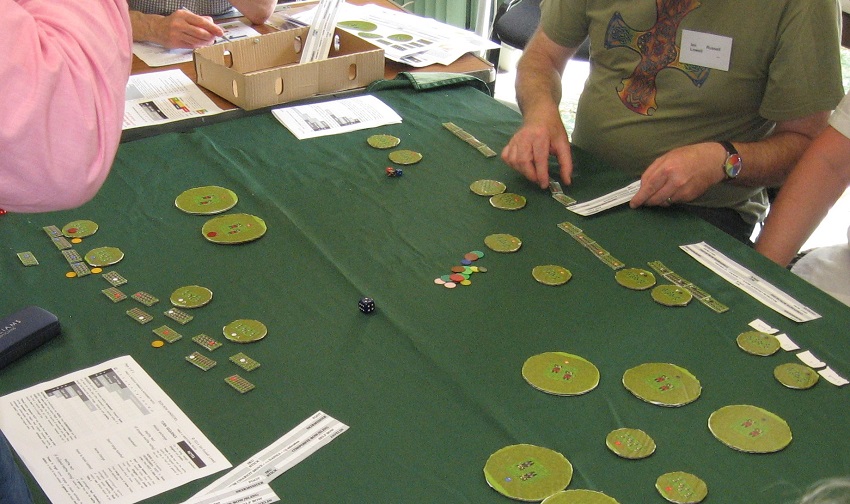
After a while in the planning, on the 19th May, we played the Shedquarters Paraitakene game with Basic Impetus.

The game was played with Trebian's classic 1/72 plastic Hellenistics (specially expanded since the playtests to provide both armies) ... and I am sure you will be able to follow the thinking and chat on Wargaming For Grownups ...


Here, I'll post a few pictures, comment that I think Impetus better suits Medieval games  ... comment that I like Basic Impetus but that our Paraitakene game was so blighted by wild die rolling that it was difficult, at times, to hold the narrative together.

(Basic Impetus: 3 javelins chucked with little hope at Eumenes' Companion Cavalry) 

... which is fine.  There were some amendments ... evading was cleaned up (and played out very sensibly ... well done, Treb.), the elephants were toned down (and the Silver Shields improved a bit).

(Paraitakene: the hotly contested Eumenid left ... elephants rout)

A lovely game but not the most historical when viewed alonside the games at Bletchley.

(Paraitakene: the Eumenid centre)

Time to get your favourite game represented. 


The astute will recognise the date - yes we were 'Royal Wedding Dodgers' ..

Sunday, July 19, 2015

10th - 12th July Knuston Hall, Northamptonshire

WARGAME DEVELOPMENTS - COW 2015: The Conference of Wargamers

My COW started immediately after the Eleanor Cross ceremonies with an attempt to identify enemy vehicles from a command post (we did OK but got no special commendations or promotions) - but the first session I presented was after breakfast on Saturday morning.

Bouvines 1214


This was a session marrying the Bouvines talk I had given at the June NBS meeting with the game I ran at WMMS.  We had just about half the session on the history and half the session on the wargame.

The historical context can be illustrated in this version of Emperor Otto IV's arms ...

This is, of course, dimidiated, the arms of England and the arms of the Empire.  It symbolises France's Western enemies and her Eastern enemies in one person.  

Otto was descended directly from Henry the Lion of Saxony and Henry II of England - he was Richard's nephew and protégée and was brought up at the English court before winning the Imperial crown for himself.  He was a career enemy of the King of France.

Otto's allied army included the count of Flanders and his low country vassals, so we can include France's Northern enemies in the mix.  Indeed, France was surrounded and the allies planned to squeeze the life out of her.

But we only need to look at the map of France before and after the battle to understand the impact Bouvines had on European history ...

 
Not only are we looking at the collapse of the Angevin Empire and a massive expansion of the authority of the King of France ... we are looking at the geographical realisation of what we can call modern France.
 
Responding to Otto's invasion, King Philip headed North East via Lille to Tournai, crossing the small river Marque at Bouvines - but realising it had all but 'missed' the enemy (and might be committed to fighting in less than ideal terrain), he ordered his army about and fell back on Lille via the crossing (intending to establish his forces further North and in good cavalry country).
 
(putting Bouvines into context at COW 2015 ... photo by Kiera Bentley)
 
The allies realised what was happening and, despite it meaning battle on a Sunday, sent a flying column under the Count of Flanders to catch the French before they had completed their crossing.
 
Meanwhile Otto would make a steadier approach via Tournai and expected to find the French in disarray when he arrived in support of the fixing attack.
 
(Bouvines at COW - the heat is on and the allied commanders assess their options)
 
In fact, probably due the shrewd actions of Philp's advisor, the Crusader veteran bishop Guerin of Senlis, the French had marched with a strong rearguard which was able to repel the repeated attacks of the count of Flanders while key elements the main army were called back and deployed for battle.
 
So, it was the allies who arrived piecemeal - and found the French arrayed in good order and on favourable ground.
 
(Basic Impetus Bouvines ... the French command post)
 
(Basic Impetus Bouvines ... the Imperial command post)
 
The battle was decided by the mounted nobility of both sides in a fierce battle of charge and countercharge ... so I opted to recreate it with modified Basic Impetus.   The figures are 15mm from my Feudal collections (a wide range of manufacturers) with some special pieces added to represent the commanders and their prominent battle standards.
 
(Bouvines at COW - in the centre King Philip charges forward with the Oriflamme but nearer to us, the count of Flanders is prevailing)
 
In our game, the battle went much more to the allied plan ... repeated attack under the count of Flanders pushing the French rearguard back into the outskirts of the village by the end of the afternoon.
 
We ended up with something like an honourable stalemate in favour of the allies.  Of course this is substantially different to the historical outcome and the most favourable to the allies of the refights I have staged.
 
It certainly does vindicate the allied plan - but also perhaps vindicates Verbruggen's suggestion that after their forced march to the battlefield and the disordering effects of filing up the road, the Flemish knights may not have been in the best condition for battle (and I had not so handicapped them).
 
Historically, although most of Otto's leaders were captured, he escaped - but within months was deposed by Frederick II who restored the Hohenstauffens.  And so, as well as defining Anglo-French history, the battle at Bouvines changed the course of history in central Europe and the Mediterranean.
 
I had a good number for this session, and they seemed to enjoy the mix of history and game play.
 
Saturday ADG ... Sink the Bismarck ... David and Goliath ...
 
Other ancients games going on over the weekend included the latest version of Trebian's Rapid Raphia Hellenistic card game, a return by Ian Russell Lowell to his Rein-Bow Warriors stable and my Yarmuk game (below) ...
 
(COW 2015 ... the sheer variety of game periods and styles)
 
(IRL's Rein-Bow Warriors ... 2015-style)
 
My own contribution to the After Dinner phase was a 5 player participation game of Sink the Bismarck using some simple new rules I have been working on and the old Airfix 1:1200 set of waterline battleships.
 
(Bismarck takes a critical hit)
 
That's all for another blog - but watch out for some good stuff if you like simple rules.
 
We wound the evening up with a few games of the innovative W1815 quickfire boardgame, a Waterloo anniversary singalong and some late games of David and Goliath in memory of the inimitable Andy Gittins.
 
(more COW: you miss as much as you see, inevitably)
 
 
Yarmuk 636
 
Sunday morning I was back on station, presenting a wargame approach to ancient and medieval history ... Some of you will already have seen my Yarmuk project which combines Phil Barker's oldest figures with his newest game in an exploration of one of the pivotal battles of Islamic history.
 
(Yarmuk at COW: another ideal number which included DBA's author Phil Barker - who also donated the splendid vintage figures)
 
I was very pleased that Phil and Sue were able to attend this session, and I hope they enjoyed seeing the old figures in action.   They suggested I take on these old figures (Phil's first ancients, which he painted to play ancients with Tony Bath) when he saw my Lords of the Nile project which featured refurbished flats from the Deryck Guyler collection (though the majority were by Tony, not Deryck).
 
(Yarmuk at COW: an excellent bit of 'point and shoot' as the armies close)
 
Yarmuk was a huge battle East of Damascus where the largest army Eastern Rome could muster was drawn forward into a protracted battle of envelopment by a much smaller Arab force under Khalid ibn Al Waleed.  It is another little known battle which changed world history.
 
(Yarmuk 636: Khalid ibn Al Waleed under the shade of a palm tree)
 
In the version of the game we played, some striking early die rolls were cancelled out and all commands in the game suffered losses.  Eventually Vahan broke Amr's main line while Khalid broke Quanateer's left flank setting up something like the historical final day showdown.
 
In fact, something of a rarity, we decided to leave the battle at that point as coffee and biscuits were being served in the hall and honours were about even.
 
(Yarmuk at COW: on the far side Quanateer struggles to face Khalid while - foreground - Amr counter-attacks vigorously)
 
Also a rarity, the majority of players were new - or relatively new - to DBA ... needless to say, they were playing freely within a few turns: Phil and Sue were able to enjoy the action while I just had to help with the combat maths and keep the players on the turn sequence.
 
Thanks to everyone who attended these sessions - they seemed to go well (I hope you enjoyed my take on historical battles) ...
 
We acknowledged the Society's 50th birthday, Andy's parting, played DBA and Gladiolus and sold some Society games.
 
************************
 
As an innovation in memory of Paddy Griffith and his irreverent take on military history, there was a ballot for the Flaming Pig award (who made the best contribution to the Conference) ... Bob (Wargaming Miscellany) Cordery deservedly won but I was honoured to get a nomination.  Thanks, whoever it was ...
 
If you want to come to COW next year, book early (it seems to sell out earlier and earlier these days)


Tuesday, March 10, 2015

8th March, Wolverhampton


Alumwell's 2015 Show

Sunday saw the West Midlands show at the familiar Aldersley venue - and a busy and enjoyable day it was ...

I took along a Basic Impetus version of the 1214 Battle of Bouvines (one of the most important battles in English history ... but less well known than many) ...


The battle was presented in glorious 15mm on the adaptable ceiling tile terrain layout that I use for short projects.

Bouvines was the key battle on the Magna Carta timeline: the culmination of a generation's worth of diplomatic work to strangle the French in a combined campaign from England, Flanders and the Empire.   

(the flower of chivalry line up on the open ground North-East of Bouvines)

(the game in play ... with markers showing the current VBU of affected units)

The French army was caught crossing the river Marque at Bouvines and found itself trapped against the marshy river by a peremptory allied attack.   This might potentially have caught the French in some disarray but, in fact, Philippe's army was able to get into battle order very efficiently - particularly the hard pressed battle under the Duke of Burgundy.

(French baggage slowly negotiates the passage over the Marque)

The emphatic nature of the French victory at Bouvines doubtless diminished King John in the eyes of his barons, and left Philippe strong enough to support the baron's rebellion with an army under his son prince Louis.

It is almost certainly a direct consequence of this battle that King John found himself obliged to put his seal to Magna Carta in 1215.

I will post more about recreating the epoch making battle of Bouvines in a future post.

Many thanks to the visitors and enthusiasts who joined in the game or discussed the battle during the day.  It was great to meet you all.

Our pitch at WMMS was again next to the Lance & Longbow Society who had a splendid participation table of the Medieval Baltic demonstrating Lion Rampant.


The game was particularly note worthy for its atmospheric glittering snowscapes ...

(the Lance & Longbow Society's Lion Rampant game)

Had I not been manning the Bouvines game I would have been keen to give this one a try.

Another great ancients game, this time WRG 6th edition (old soldiers never die) from the Border Reivers on beautifully sculpted terrain boards ...


Another busy day, but I got pictures of a few more games (not really ancient/medieval, but here's a collage) ...


... and if that wasn't enough to keep people browsing, there are always living history groups and a well supported modelling display.


And I liked the Anglo-Sikh game ...


Well - plus the shopping, that's an enjoyable day out for any enthusiast ...

As last year, someone foolishly set off the fire alarm which meant evacuating the building for a few minutes ... I think some visitors took that as their cue to go home as, post interruption, the show didn't quite resume its previous activity level (and quietly tailed off to home time) ...

Everyone I spoke to seemed to have had a good day, however ...

Monday, July 14, 2014

11-13 July, Knuston Hall, Northamptonshire

The 2014 Conference of Wargamers

There are so many good things to say about CoW that it is hard to know where to start.  Let's just say that the mix of people is excellent, the attitude convivial throughout ... the accommodation is ever improving and, to my taste, the catering (which barely stops all weekend) is a good 8/10 (for reference: no other wargame venue I have been anywhere in the world has topped 7, and I can't afford 10).  

The bar stays open till you go to bed and seems normally priced.  

The wargaming is 9:00 am to, say, midnight and just stops 4 times for main meals or tea/coffee (with home-made biscuits and cakes - indeed, a cream tea, this year).

Anyone can come so book yourself a wargame holiday.   If there is a problem, it is that the event is just the two days and most sessions only run once - so there are always great sessions you miss (especially if you are putting stuff on yourself) ...


For me, the weekend started with an outing to Cropredy Bridge to look at the ECW (1644) battlefield, and finished with re-running my 20th Cent. Naval 'pop up' game for an old friend ...


In between, I put on two main sessions and aided in an ADG (all ancient/medieval), played landsknecht cards, drove a T55 tank and commanded a detachment of French regulars in Canada ... I joined in on some innovative games, ancient, renaissance, Lace Wars and both World Wars, there was a morale boosting sing along (seriously ...) and a crisis game in a time shift ...

Gladiolus ...

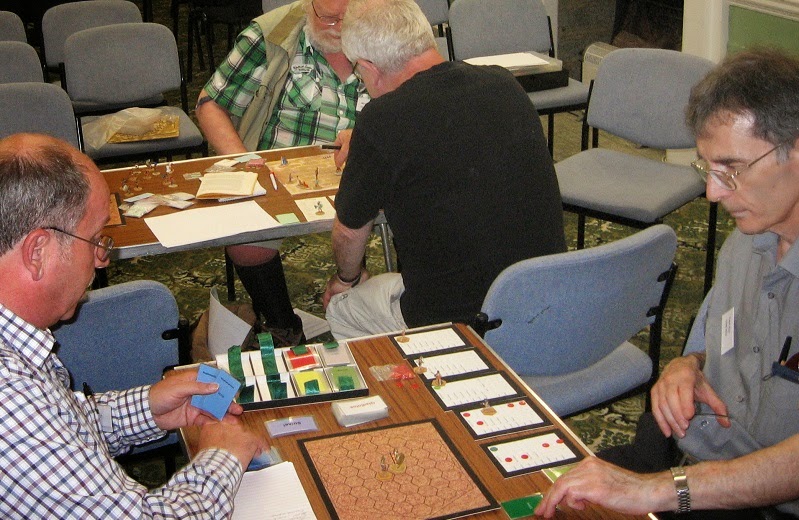
For late night entertainment on the Friday, Will revived Gladiolus and I took along a set - at one stage we had 4 boards in play with several players being introduced to the Society of Ancients classic combat game.

(Gladiolus at CoW: you can teach old dogs new tricks - or should that be the other way round?)

I understand that the game is now out of print and is one the Committee is considering reprinting: so it was great to see players taking to it instinctively, getting good games and entertainment to start their weekend

(a 'made-over' Gladiolus set featuring hexes rather than offset squares, and some nicely laminated cards)

(15mm Gladiolus from Outpost ... 20mm Gladiolus from the old Atlantic plastics set)

Before retiring, I got in a game of Doodlebuggers with WD Display Team North, and set up Montaperti for the morning ...

(Doodlebuggers: normally I would edit out the beer bottle, but a 'London Pride' beside a defeat the doodlebugs game seems fortuitously appropriate)

Montaperti 1260

This was a shameless plug for the Society of Ancients BattleDay.   It is Hydaspes next year, and this year my take on Montaperti using Basic Impetus (plus) was flagged as *Best Game* (so has become my advert for the event).

(Montaperti at CoW: the players announce their intentions)

We had 2 players a side plus some non-playing participants, and in the 2 hour session, managed an intro to the BattleDay, briefing on the battle, guide to the rules, plus completed the game (the Florentine army broke at 10:50 with the session due to end at 11:00)

(Montaperti at CoW: the disarrayed units are broken; the numbers behind units show their current VBU)

The Florentine cavalry wing severely battered the Sienese army's tough German contingent driving them back to the Arbia but failing to break them, meanwhile their pavisier/crossbow units were unable to hold in the infantry line.

(Montaperti at CoW: a closer look at the combat)

(Montaperti at CoW: knights from the Sienese rearward reinforce Lancia's Germans on the banks of the Arbia)

... and the flanking force under the Duke of Arras arrived in good time behind the Florentine left.

In fact, it was neither the Sienese reserves nor the flank march that settled the day - the Florentine knights finally ran out of steam - and then their losses combined with the infantry casualties across the ridge were just too much.   In the basic game, this 50% value would mean the loss of the army but in historical games, I replace it with an ever worsening die roll - in the first instance the army must roll at least a 2.   

In fact, the test resulted in a 1 and meant we could wrap up without running over into the coffee break or needing an artificial solution.

The players seemed to have enjoyed all this  - as a recreation of Montaperti and as a run through of Basic Impetus.

Saturday:

Here's a quick look round at some of what else CoW had to offer on Saturday ...

(a 15mm German Apokalypse occuring at the main railway station)

(anti-tank missile debris on the lawn following a massed tank attack)

(the French marching on Quebec)

(another lawn, another battle: Little Cold War action)

(German Peasants War ... cardboard Landsknechts)

And for my main evening entertainment, I played the French regulars in a huge game of Muskets and Tomahawks ... 


Commercial games - especially of the glossy sort are a rarity at CoW and only get brought along if people really think you ought to know about them, so I was pleased for the chance to get an objective look at this much hyped product.

(Muskets and Tomahawks: scenes from our raid on the village)

Ancients games ...

... and in addition, Trebian ran a multi-player version of 'To Ur is Human' - an excellent treatment of the earliest period of warfare which we have been helping him test and perfect on a Wednesday night ...

(To Ur is Human ... battling for the fields and gardens of ancient Mesopotamia)

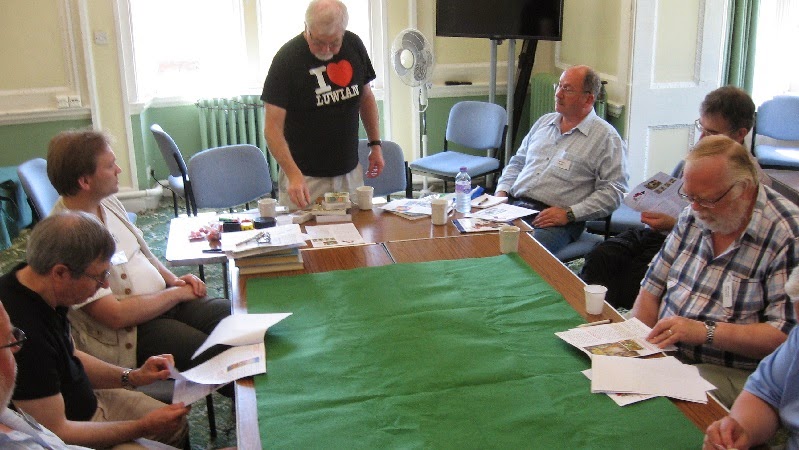
Former SoA President Ian Russell Lowell contributed sessions on German soldiers, cardgames and Hittite raiders ...

(IRL is the only person I know who sports an 'I love Luwian' tee shirt ...)

... in addition, Treb came up with a last minute 'pop-up' - Rapid Raphia, an attempt to make a quick-fire but satisfying game out of the massive Hellenistic pike and elephant clash ...

(Rapid Raphia: two boards going side-by-side)

This looked like an innovative success which I think I am destined to play in our weekly local get together this week (and we might try it out at a show, I'm told ...) ...

Before turning in on Saturday, I set up my Northampton session for the morning.

Northampton 1460

Whereas my Saturday session was more of a game with attenuated presentations, 1460 focussed more on the discussion of the battle, location and reconstruction, and on the work of the Northampton Battlefield Society.

(Northampton 1460: me behind the camera, Mike Elliot talking about the battle)

It was great to have a good number of participants, and in the second half of the session, I presented my ideas for wargaming the battle, we worked through the game ideas I have developed and came up with some really good period enhancements ...

(Northampton 1460: the final stages of the Yorkist attack)

(Northampton 1460: Lancastrians man the barricades at Delapre)

(Northampton 1460: the battlefield viewed from the North - NNW)

This session went really well and I am looking forward to modifying some of the attendant mechanisms for the outing at Kelmarsh Hall (History Live!) with the Battlefields Trust next weekend.

*******
Of course, I was helping a session on Friday night, the presenting both mornings, so other people's weekends would have far more diverse than the weekend I managed to cram in.

So maybe we will see you next year?

More on Cropredy (ECW Battles/Cropredy); more on 20th Century CoW (P.B.Eye-Candy)

(Montaperti at CoW: battlefield panorama)

(End-piece: this engraving of the Eleanor Cross at Hardingstone hangs in the Hall at Knuston - it is the landmark from which Archbishop Bourchier and Legate Coppini watched the battle of Northampton)