Showing posts with label Battle of Bosworth. Show all posts

Saturday, September 4, 2021

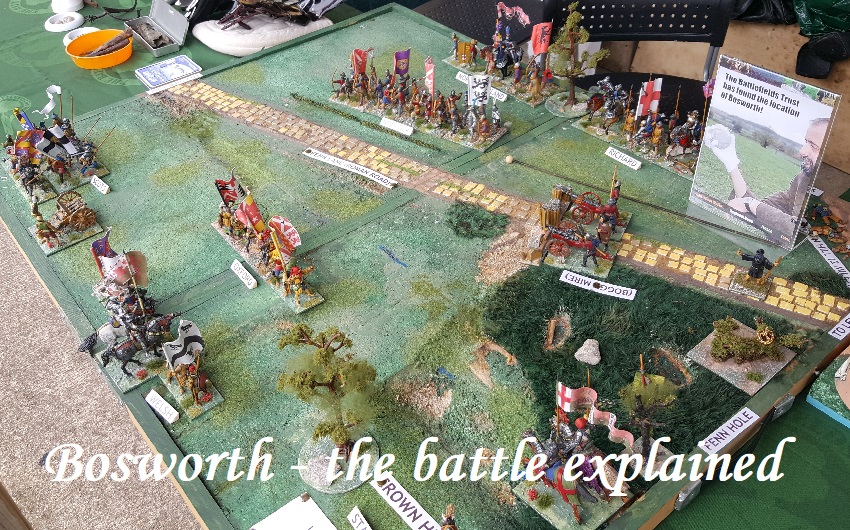
DBA Special: IV/83a/b Wars of the Roses Yorkist/Tudor at Bosworth (54mm)


 WARS OF THE ROSES 54mm BOSWORTH 1485

These bespoke armies were configured during the development phases of V3 and represent my thinking of how the historical orbats translate for DBA.  I'll point out the deviations where they occur.

The number figures on a base is also not as specified (purely in order to have a comfortable fit for the 54mm figures on a conveniently sized element stand).  The bases are 80mm wide, which allows for a 4 ft wide table.  The mounted are all 'Kn' and are 2 to a base.  The foot are all 3 per base except for hand-gunners/psiloi, but there are several double bases (so 6 figures in 2 ranks).

 
(me using the 54mm DBA game to explain the battle to cricket legend Freddie Flintoff)
 
Each army has  3Kn general
 

 Richard has 2 more Kn although Northumberland can only move on a Pip roll of 5 or 6

 
(Richard's cavalry at Bosworth: 54mm DBA Wars of the Roses)

The earl of Richmond might get some support from the Stanleys


(Henry Tudor and the Stanleys)

The infantry

 
(the Yorkists)
(the Tudors)
 
For the Tudors, I chose to represent the earl of Oxford's Anglo-Welsh vanward as a traditional mix of bows and blades

 
(Vanward ... 2 x Bw, 1 x Bd: Talbot, Oxford, Savage)

With the Welsh in the mainward a mix of Ax (Ap Thomas) and Bd (Tudor/Pembroke)

 
(Tudor ... 1 x Ax, 2 x Bd)

... and for best effect, the mercenaries (Pike), I chose to represent as 8Sp.  They can be played as Pk, of course (the difference is interesting but probably not a game changer) ...

 
(Henry's mercenaries under Philibert de Chandee and Bernard Stewart d'Aubigny)

Royalist/Yorkist

Contempoaries  describe Norfolk's solid line as a rampart compared with Oxford's slender line.  I therefore took advantage of V3's 8Bw (Lb) troop classification to show this solid mix of archers and combat troops (it certainly looks right to me).  I take the Burgundian 8Lb in list IV/85 to be based on late 15th Cent English practice (so this interpretation isn't straying from DBA orthodoxy by that much, really) ...

(Somerset, livery, Norfolk and Catesby)

The figures in this army are a liberal mix of old plastic soldiers (Britains, Timpo), more modern 1/32 figures (Airfix, Italeri etc.) and metals by Irregular Miniatures.

The splendid fabric flags were researched and created by my lately departed friend, heraldry buff and wargame project collaborator Graham Fordham of Fluttering Flags.  Even though he was mainly a 28mm enthusiast of late, these scaled up versions really make the best of 54mm's visual impact.

Without anything much in the way of field artillery in this scale I adapted the pieces in Irregular's 40mm Renaissance range.  The designs basically work, and so a relatively big 40mm gun becomes a medium piece in 54mm.  The Ribauldequin is simply several such, crafted into one.

 
(some of Richard's seven score serpentines)


(54mm Bosorth DBA ... 1 x Art, 1 x (handgunners) Ps: Tudor)

CAMP

Neither side's camp played any part in the battle so they don't really need to be depicted in the game.  Some say the finds associated with Whitemoors relate to Richard's camp, so it makes a fun albeit tactically insignificant addition to the set up.

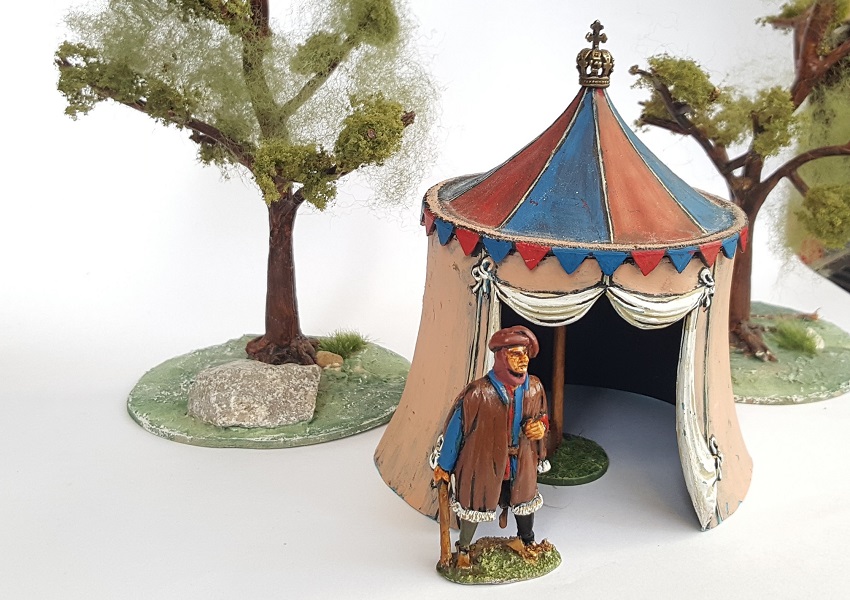
(54mm DBA IV/83b: Ricardian camp scene)

The vignette includes an Irregular Miniatures cart in difficulties in the marshy conditions typical of the battlefield ... for completeness, it incorporates a Camp Follower element which shows the Stanley family's Lord Strange (a hostage in Richard's camp) accompanied by a mercenary headsman.  Needless to say, I wasn't actually there, so can't say how authentic this scene might be.

The camp area is completed by a fairly successful repaint of the old Timpo plastic medieval tent.  Lovers of detail might like that I have topped the tent pole with a crown finial ... it's actually an inexpensive bracelet ornament you can buy in the Heritage Centre Shop (it really is an authentic Bosworth souvenir.  Who would have guessed?)

 
(Bosworth 1485: Yorkist tent with Murrey and Blue details)

 
(Camp Follower element: Lord Strange)

I also made a thorn bush:

Friday, September 3, 2021

21st - 22nd August, Bosworth Battlefield Heritage Centre, Leicestershire

(commemorating the battle anniversary at the Heritage centre)

BOSWORTH BATTLEFIELD HERITAGE EVENT

Much affected by Covid uncertainties, the annual Medieval Festival at Bosworth went ahead in a reduced format this year ... a Living History and Commemoration, but without the big reenactment and Medieval Fair.

 
(my DBA version of the battle on the Battlefields Trust stand)
 
The Battlefields Trust were happy to support the event, and went along with my 54mm DBA version of the battle as part of the BT stand.
 
Indeed, Julian H had his 'Wars of the Roses in 10 minutes' in the lecture pavilion, using swoppets, and a team of locl wargamers were doing a big version of the battle using Never Mind the Billhooks opposte us - so, after my subtle introduction of the figures back in 2014, model soldiers and wargame approaches now seem to be bedded in at Bosworth! 


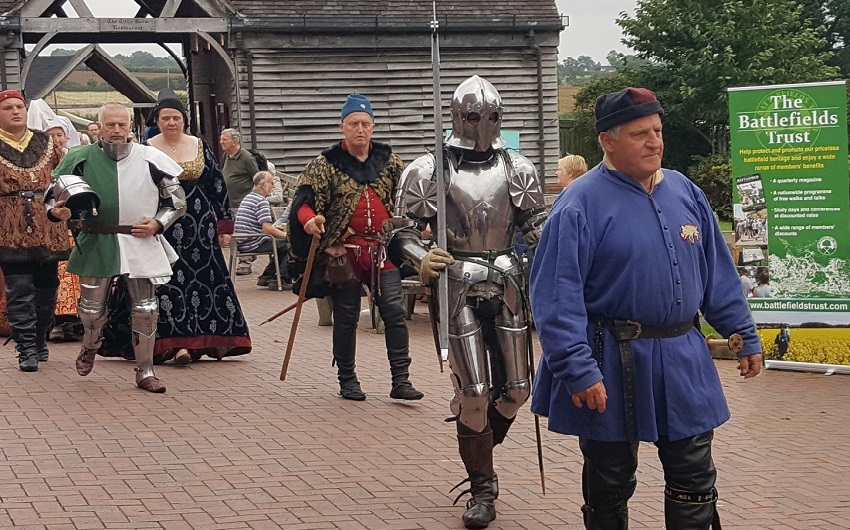
(this year, the Battlefields Trust stand was strategically placd on the commemorative procession route)
 
(Henry's mercenaries 'ready for battle at Bosworth Battlefield')

 
(scenes from Bosworth 2021 ... including the lecture pavilion, Richard in battle and Living History displays)

(miniature action at Bosworth: DBA )

 
(miniature action at Bosworth: Never Mind the Billhooks) 
 
So a lower key event than usual at Bosworth, this year, but more time to meet people, forge links and reflect on the tumultuous events of 1485.  A place-holder for the return of the big battle next year - and a rare opportunity for me to do both days ... usually the Sunday of Bosworth is Partizan in Newark (which, this year, again fell victim to the pestillence) ...

The good news, however, is that the Autumn version of the show The Other Partizan is confirmed for October - and things are looking good.  Ancients is back on the move, you might say.  Our odyssey continues.

 
(roses are laid at the Bosworth sundial)

Tuesday, August 31, 2021

15th August, Shaw House, Newbury

The delayed 2020 Society of Ancients BattleDay - 1485 Bosworth Field

So, by coincidence, the BattleDay eventually took place barely a week ahead of the anniversary.  The usual venue wasn't an option, so the organisers opted for the splendid Shaw House in Newbury, veteran of the 1644 Civil War battle, and well worth a visit in its own right.

(Shaw House, Newbury)

Overall, the event attracted 45 participants.  There were 11 tables featuring 10 rulesets (as the Peter Pig roadshow came with two Bloody Barons set ups).  I think this was a first time for Martin and friends so that was a bonus.

This year the intro talk was my quick summary of the background (along the lines published here a few days ago) and some points to ponder (about orientation and about artillery)

We then got onto the games which included my trusty 54mm DBA which we played 3 times altogether (2 wins to the earl of Richmond, 1 to Richard) ... I also played in Nick's HoTT variant (the Magic of Bosworth) which I think was also a Tudor win)

The Games


I was able to sit in on the Armati game which seemed to flow very well and featured a mass of veteran 20mm figures from Roy's collection.

Eye Candy


As you can see it looked splendid, and everyone seemed to have a great day.  Other than the games I commented on above, I await a future Slingshot to see how well they all went.
 
Next BattleDay will be Adrianople.  Get out your Goths!

Saturday, August 28, 2021

BattleDay 21 preview: Bosworth 1485

 Bosorth Field ... what's in a location?

In 2010, the Battlefields Trust completed an archaeological project which identified where the battle of Bosworth was actually fought - the evidence was conclusive, and, contrary to a tradition popular over the last 200 years, it was not fought on Ambion Hill.

(Bosworth Field)
 
Apart from anything else, it was pretty much fought on the flat.
 
In the case of Bosworth, we can pretty much pinpoint when we 'lost' the battlefield.
 
Speed's map of Leicestershire is from 1610 and marks 'King Richard's Field' and when you compare his location with the archaeological trace, it seems that, after 125 years, people still had a fair understanding of the location.

                         
(detail from Speed's Leicestershire, 1610)

Click for a bigger version. If you look a line from Shenton to Dadlington, you will see that maybe 70% of the field is West of that line.  If you compare it with the finds map (below) you can see how closely it is validated by the archaeology.


(finds map, Bosworth battlefield)

Compare that with the Ordnance Survey map of 1810, and it is evident that something has changed:
 

(OS Map of 1810)
 
The area of the battlefield West of the notional Shenton to Dadlington line has disappeared and is now concentrated up in the area of Ambion Hill (where archaeologists will later find, pretty much, nothing).
 
How did this happen?  In his study published in 1788, William Hutton mixed local anecdote with 'clues' in Holinshed to propose a detailed battlefield based on Ambion Hill, which was picked up by subsequent antiquarians, and by Ordnance Survey.  It quickly embeded itself in maps and books - and without any real foundation, became the 'orthodox' location for the next 200 years.
 
There was never any archaeology to support the Ambion Hill location, and very little sense could be made of the primary sources.  Many books have challenged the orhodoxy over the years - but it took intensive archaeology to reveal a convincing alternative.
 
 
 (some of the 32 canonbals found marking the site of Bosworth Field)

In addition to the cannonballs that provide compelling evidence for the site itself, the archaeologists also found a 'high status' silver gilt boar badge, surely closely associated with Richard and his closest personal supporters in an area of Fenn Hole, marsh in 1485.

 (Richard's emblem - the white board)
 
It seems very likely that this marks where the King met his sticky end, and Plantagenet gave way to Tudor
 
(Fenn Hole today ... there is even a thorn bush)

The archaeology does not tell us the exact orientation of the troops or their deployments, and as the much delayed BattleDay approaches, the presenting teams will be making their assessments.