Monday, March 24, 2014

22nd March, Alton


OK - here's the way it works ... each player takes along a suitable pair of armies (there's a preference for historical opponents - and balance, of course, is down to the player).  At the start of the day players randomly draw their match numbers.  All games are 'odds' vs 'evens', and in round one, 'odds' get to use their own pairing ... in round two, 'evens' get to use theirs ...

When it is your pair in play, the opponent gets to choose which army to use (and vice versa).

I took a pair to recall 'the Axumite Invasion of Arabia' ... Abyssinian & Horn of Africa (II/62) and Later Pre-Islamic Arab/Nomad (II/23(a)  ... We are in the 6th Century AD.

(thrice deployed by mine enemies: the Arabian Nomads)

We were all present and signed in before 10:00 which meant we were able to have 1 hour game windows, 3 before lunch and 3 after.  So 6 games, 3 of which would be with your own scenario.  A pretty good return for a day trip to Hampshire.

In every case my opponents chose the Arabs (ironically, given I had tried 3 games with my local wargamers during the week, notionally to 'test' for balance and the Arabs had lost all 3) ... one game went down to the wire but the Arabs snatched it, one clear win to the Axumites, and one walk over to the Arabs - so (after 3:0 to the Africans in the week) 2:1 to the Arabs on the day.   And a rare DBA win with my own armies to me.

In the other games, I got to play Sicilian against North African/Sicilian Muslims, Alexander against Darius and Samanids against Saffarids ...


I picked the Sicilians as the are a classic Phil army so I was familiar with their modus operandi.  Actually I lost narrowly (I failed to destroy a Psiloi with a Knight General - so 4:2 with quick kill to the Knight - to win the game in my turn, then succumbed in the enemy turn that followed ... Hmmm)


I picked Alexander as he won historically - and also I thought the artillery might give me a long range shot or two.  Actually I handled it badly and it got killed by Light Horse without firing a shot, by which time the high rolling Scythed Chariot was in amongst my line.   It took a while to sort out the mess and I was 2 down before I really got going.  I pulled the deficit back but eventually lost what turned out to be a very close game.


A real roller-coaster of a game.  I chose the Samanids because they had an elephant.   I might have done so anyway (elephants are part of the ancient wargame if you ask my opinion) but further, my opponents were giving me the Axumites all through, so my elephant game was warmed up.  

I was very pleased to get the elephant in on some Warband and then (uncharacteristically) rolled high enough dice to take them out.   I did equally well on the right flank, and with Bowmen and Auxilia against Warband and Auxilia ... and that was enough to get me over the line in another tight and entertaining tussle ...

(around the tables ... the Ishtar Gate BUA was subbing as Sardis)

There were lots of other great pairings in play (you wished the day had opportunities to play more of them, really ...) with Early Muslim North Africa & Sicily popping up an improbable 3 times, and Early Bedouin twice.

One of the Bedouins fought Makkan ...

(1/8(a) Makkan vs 1/6(c) Early Bedouin)

Possibly my favourite game was Martin M's Lydian vs Persian complete with Cyrus's war towers ...

(1/50 Lydian vs 1/60(b) Early Achaemenid Persian)

As has become the custom, there was a full table of prizes which players could choose from in addition to the trophies which this year were a colossal Pharaoh for the winner and a splendid Greek style plate for the runner up.   Prizes ran from two deluxe painted armies ready to go into action down to individual figure packs, Barker Markers and scenic items ... everyone got something.


(a couple of views of the trophies and painted army prizes) 

The results were ...  1. Mark Skelton (Makkan v Early Bedouin) 119pts; 2. Martin Myers (Cyrus v Croesus) 101pts; 3. John Drury (Early Bedouin v Kassites) 98pts; 4. Bill McGillivray (EMNAS v Sicilian) 98pts; 5. Paul Clair (Attila v Aetius) 95pts; 6. Paul Hodson (West Franks v EMNAS) 82pts; 7. Colin O’Shea (EMNAS v Al Andalus) 79pts ... Scott Russell (Athens v Sparta), Terry Ellis (Thebes v Phokis), Phil Steele (LPIA v Abyssinian), Dunc McCoshan (Saffarids v Samanids), Denis Grey (Alexander v Darius), Robert Dowling (Nikephorians v Georgians), and Martin Smith (Thessalian v Illyrian) also played ...

(and here we are ... Martin with his eyes shut, and me edited into my own photo at the back to make the numbers up ... )

See you next at the BattleDay on Saturday ... or maybe at Salute next month?

Monday, March 10, 2014

9th March, Wolverhampton

Alumwell/WMMS 2014


Many thanks to Alumwell for finding space for us at their very friendly and enjoyable WMMS show.  

Well worth attending if you can make it, WMMS has, for its size, a really impressive mix of games and displays and all the main traders ... but it retains a West Midlands family feel and you always seem to get talking to people.

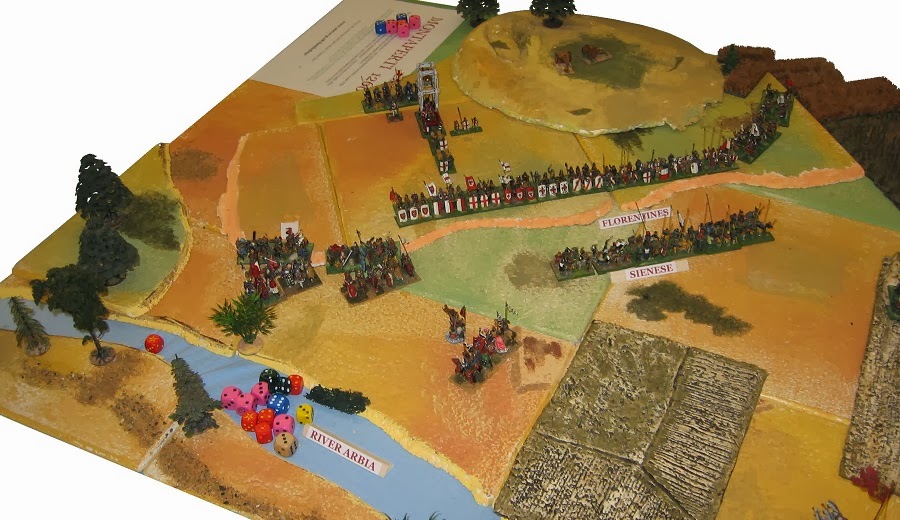
(Montaperti 1260 by The Society of Ancients)

We took along the latest version of my BattleDay promo game, Montaperti, a Basic Impetus Plus participation game in 15mm, now on a browner Tuscan landscape (the battle was fought in early September), and we got a couple of really useful development games under our belt.

But more of that anon ...

(family show: SoA's Montaperti game being enthusiastically played by renegade youngsters from the Lance & Longbow Society entourage)

I was busy most of the day but managed a trip round at lunchtime ... quite a few eye-catching games in a variety of scales and idioms, although not so much in the ancient and medieval period:

(WWII vehicles, Norway 1940, Hougoumont, Lace Wars weapons)

Trends are seldom worth analysing as wargaming is a very personal interest - so 'trends' may just reflect what people are doing, and what is selling well, at a particular point in time (i.e. they are as much snapshots of random taste as indications of trends and patterns) ...

But the Ancient and Medieval content was ourselves (Basic Impetus/Montaperti) and Lance & Longbow (DBA/Wars of the Roses), plus Peter Pig (Longships/Viking raids), Crossed Lances (jousts and tourneys) and Saga.  I may have missed something key, of course, but the ones I noticed set a tone that was predominantly Dark Age/Medieval.

(18th Cent. North America)

In addition to WWII perennials, there were any number of 17th and 18th Century games (plus the Lace Wars reenactors who are Alumwell regulars) ... and a couple of Zulu War games.

Everyone I spoke to was very happy to explain their games and seemed properly briefed to do so ... so thanks to them all for taking the time.

(Sprawling 28mm Rorke's Drift game)

(WWII weapons, Balaclava, ECW and some Lace people)

(British Civil Wars: Ireland)

(More Zulus)

(Jacobite Rebellion)

There were quite a few participation games going on ... in addition to Montaperti and the WotR DBA games, Peter Pig's Longships game seemed busy, and plenty of players seemed engaged with the Wings of War table.

(some WMMS participation games: DBA, Longships, Wings of War and Crossed Lances)

There were plenty of young faces at this show and they seemed to be enjoying themselves.

The show also has quite a busy Bring & Buy which seems a popular and well supported feature (Chris picked up a splendid Ottoman army for FoG-R use, so I will have to figure out how to shelter Landsknechts from massed artillery ...) ...

(Wars of the Roses 28mm figures from the Lance & Longbow's DBA game)

Apologies to anyone whose game I have missed: I only had a brief window to get round and there was a lot to see.

Back with Montaperti, we played through a couple of times with very different results - both of which I think vindicate where the game is going.   

In the first game, aided by some youthful extreme dice rolling, the inferior Florentines drove the Sienese off but ultimately collapsed as a result of rolling just so many 5s and 6s in cohesion tests.   Nevertheless, it demonstrated that the underlying game is reasonably balanced.

(desperate Florentine spearmen attack the Sienese lines while the crossbow contingents continue shooting)

Apologies to purists for the numeric VBU* tags behind the units (casualties noting each level lost would be better, but I am still getting used to running the whole game, so find the positive numbers make it easier for me to manage).

The play was more canny in the afternoon game, but ran to script initially as the imperial and Sienese cavalry broke through the Florentine wing, causing a flurry of activity all along the line.

(Imperial and Sienese cavalry gain the advantage on the Florentine right)

The untrustworthy Ghibelline contingent were ordered up to plug the gap ... and rather surprisingly did so, keeping much of the Sienese wing at bay.

Nevertheless, after their compatriots had fled, it was impossible to block all of the enemy - and a victorious Imperial contingent broke through and attacked the Carroccio/Bell Tower.  Although this is a reasonably fair fight, in one calamitous round, the Carroccio's VBU (basic strength) dropped to just 1, seeming to make a Sienese win inevitable.

(Montaperti: the battle for Martinella)

... or possibly not ... the combatants then failed to register any hits either way, buying time for some plucky Florentine crossbowmen to intervene from the flank, destroying the Knights (as the Knights lost the ensuing melee phase) ... rendering the battle unwinnable for either side (both armies falling below 50% of their total morale values in the following turn).

This game certainly did make it seem that the behaviour of the Florentine Ghibellines is key to the outcome of the battle: had they failed to respond to the Florentine flag, this game would have been over very quickly and with scarcely any impact on the Sienese.

The Society of Ancients BattleDay is on the 29th of March in Bletchley, MK ...  There are still places available for visitors (priced £7 or free to youngsters ... see the BattleDay page on the website for more info) ...

*in Basic Impetus, units have a morale/strength value, a VBU which reduces with each hit/test failed ... when they get to 0, the unit is routed (so keeping track of the current values, which I'm sure becomes instinctive, is vital, especially when running the game for beginners)

Wednesday, March 5, 2014

1st - 2nd March, Bournemouth


Every Spring, the Armati glitterati flock to the South Coast's Stag and Hen party capital, Bournemouth, for a weekend of toy soldiering ... I'm sure there is something to read into that ...

This year, the Hammerhead show wandered out of February by a week and so I'm afraid it fell off the Shows North schedule for 2014.   In fact, we had some possible volunteers, but it wasn't made clear enough to me early on so I didn't book anything.  Apologies to all - especially visitors to what I understand was a great little show who may have been looking out for us but been disappointed.

The good news is you can see the Society at WMMS next week where I will be running a Montaperti BattleDay taster ...

This year's Armati by the Sea was a classic and was dominated by the Society big beasts ...

But here are my 5 games ...

(Game one: New Kingdom Egyptians vs Sea Peoples)

(Game two: Assyrians vs Elamites)

(Game three: Polish and Lithuanian vs Teutonic Order)

(Game four: Mongol Conquest vs Chinese)

(Game five: Syracusan Greek vs Early Carthaginian)

Armati by the Sea is a scenario based competition where the organisers provide everything right down to dice and measuring tools (although bringing your own sticks and bones is accepted).   The formula was devised to simplify life for long distance visitors flying in.

The games are alotted by Swiss Chess, then a numbered coin is drawn from a bag (denoting which scenario) and tossed (marking who gets which army).

As you can see, I got a pretty happy outcome ... 2 Biblical; 1 Medieval; 1 edge of the world and 1 Classical Mediterranean. 

The beautifully presented armies are a joy to play with (assuming you forgive Roy's unblunted pin spears giving you the occasional stab) ...

(beautiful Medieval pageantry in the Teutonic clash)

This year is the anniversary of the ground shifting Battle of Bouvines, and Vincent had brought along his Armati inspired interpretation of the battle as a side entertainment on Saturday to run at breaks and for early finishers ...

(anniversary presentation of the Battle of Bouvines)

You could argue that Bouvines marked so decisive a shift in the power balance of Europe that it put Prince Louis on the throne of England in 1216.  King Louis? You ask ....  Well that's a story in English history most commonly glossed over.


By Sunday morning I was a contender, but my challenge faded away as I failed to win 2-up melee rounds with the Mongols and blundered at the Carthaginians in Sicily.

Ross Finch made a great up coming player, and organiser Peter Barham won the annual prize for killing or capturing the most enemy generals.   There then followed some presentational musical chairs ...

As I say, this was a day for the big beasts, so the traditional presenters were giving each other the awards.


President Roy Boss presented third place to Peter ... Vice President Matthew Bennett then presented second place to Roy ... then metaphorical caps were swapped and Roy presented first place and the Champion's trophy to Matt.   See - experience counts in this game!

1: Matthew Bennett; 2: Roy Boss; 3: Peter Barham; 4: Craig Tannock; plus Vincent Auger, John Bradley, Ross Finch, Tim Cull, Phil Steele, Mark Fry, Richard Shilvock, Ian Cam, Ian Kerr, Mick Owen, Paul Collins, and Bruce Rollett.

Friday, February 21, 2014

19th February, Montaperti ...

Being the next trial of the wargame for the Society of Ancients BattleDay

This time I decided to run things through with Basic Impetus (well, BI plus counter-charges and evades*)

Three reasons: it worked fine for the recent Cravant game at York; it is an Italian wargame; no-one is currently taking it to the BattleDay.

In order not to unbalance things wildly, I pretty much gave the players armies from the BI lists with minimal adjustment.

I started the game with the Sienese behind the Arbia, and the Florentines breaking camp and taking to the road


From these starting positions, the armies deploy for battle ...


The Sienese are pro Imperial, or Ghibelline, the Florentines pro Papal, or Guelph.   So the Sienese enjoy the support of a powerful Imperial cavalry contingent under Giordano Lancia ... the Florentines have the disadvantage that they have brought along a significant Ghibelline contingent (rather that than leave them back home in time of war) which they have parked at the back where they will do no harm.

Nevertheless, the Florentine is significantly the larger army ...

(the proud Florentine army takes position along the ridge)

The players pretty much followed what we know of the historical deployment, and the Sienese/Ghibelline Van galloped forward to take on their generally slightly less frisky Florentine equivalents.   This had mixed results, some being repulsed, some driving the Guelphs back ...


But the damage was done - the victorious unit had driven the enemy back towards their precious Carroccio, and, as a consequence, the Florentine player decided he had to order up the potentially unreliable Ghibellines.   They defected.

No such problems for the Sienese: they were relying on a surprise attack from beyond the edge of the battlefield - and it turned up mid battle.

(much of the Florentine line has turned around and is falling back to save the Carroccio)

But the defection of the Ghibellines would be decisive - they were called upon to plug the gap and they did the opposite.   Predictable, you might think - but I guess you don't make that call unless you are out of other options.


The battle turned into a scrappy affair around the Florentine Carroccio which the Florentines were never going to win ... In the end, the Carroccio went down ending our game and, coincidentally, also taking the morale tally for the army to defeat (so had it been a 'pick up' game, it would also have ended at that point).

Following the original deployments and approaches, coupled with the Florentines failing reliability on cue with their Ghibellines, pretty much made the game run to script.   

Good things about Basic Impetus for this scenario ...
*The VBU + Impetus bonus mechanism allows quite a lot of variation within a simple system.
*Retreating from unsuccessful combat makes melees unpredictably mobile (unlike some similarly simple rules).

Less good ...
*as the game was put on for beginners, I used numeric markers to help them keep tally of the units' declining VBUs.   A more decorative way would be to add casualty markers, but I am not sure yet.


*although in fact there were no evades in the game ...

Wednesday, February 5, 2014

1st-2nd February, Salford and York

The Gentlemen Pensioners York weekend

Due to the treatment we have received over the years, SoA Shows North no longer supports Vapnartak.   That usually means I would not go to the York Racecourse event.

However, the weekend is also the occasion of one of our reunion gatherings and Steve had proposed a refight of the AWI battle at Brandywine Creek on the Saturday together with an invitation for players to play in the Lance & Longbow Society's Cravant demo game at the show.

So, with two historical games on offer, Friday evening saw me heading North.


Brandywine may not be of interest to all my fellow SoA enthusiasts, but was a great Saturday game, and there are more photos if you want to follow the link (York Weekend Brandywine) ...

Last seen at Salute, Cravant is a visually splendid game, and intriguing as a scenario.  It is set up for Impetus - which I still have not played that much - so I was keen to get some more mileage in.


The battle is essentially an attempt by an Anglo Burgundian army to come to the aid of Cravant which had been besieged by the French in the opening moves of a new campaign in the Hundred Years War.

Henry V had died, and England was in the hands of a minority ... so the Dauphin saw this as the time to break the agreed peace accords and renew hostilities.

Salisbury led the Anglo-Burgundian force, and after a stand off across the river, ordered his troops to ford the Yonne.


For the reconstruction, we had three players on each side ... a compromise between allowing show visitors access to what was going on and sufficient players to simulate the allied nature of both forces - I hope we got the balance right (I am not aware of turning my back on anyone but there is always a risk).


I took the central, but weaker, Burgundian battle.  We were first to get our feet wet.   

The river was waist deep but as on the day proved to be no real obstacle.    The waist-up figures on clear bases added to the spectacle for viewers (though have no game function) ...

(Salisbury's battle crosses the Yonne)


In the (modified) version of Basic Impetus in play, my crossbowmen were significantly less effective than the English archers on either side of me, and a rule was in effect allowing casualty effects to be 'passed back' further hampering my small contingent.

Whilst the English under Salisbury and Willoughby were smashing forward, I was losing the central slogging match ... driven back almost into the river.

(in the centre, the Burgundian contingent were taking a battering)

I was obliged to fall back, but this enabled the victorious English from both sides to come to my aid (without which the Burgundians would doubtless have eventually broken)


Meanwhile, Willoughby had pushed across the bridge and, supported by archers alternately wading and shooting, had secured a strong position between Cravant and the main battlefield.  He too gradually ground the enemy down.

(Willoughby's battle, archers to the flank, the walls of Cravant in the background)

The major French successes in all this were mainly to the far flank, where they broke through the end of the line, pursuing across the river by the mill ... then turning back on Salisbury's rear.

Had the English commander not destroyed the French to his front, this minor encirclement could have been devastating - however he was able to respond and stall the attack and the reverse was really too far from Cravant itself to affect the outcome of the battle.

(Cravant: the siege relieved ... although a major fight is still playing out on the far flank, the English and Burgundians command the approaches to the town and most of the French army has fled)

A splendid game, and one which caught the eye of many a browser.

The battle was played to a conclusion, lasting about three hours, mostly before we took a break for lunch (OK, we probably needed a sign for 'resumes at 2pm').

The York show doesn't change much and remains the same mix of big figure static games, fantasy pulp and shopping.   I got some 15mm Vikings and Saxons, plus some little aeroplanes from Peter Pig, Donnington and Irregular, and some Landsknechts from Museum ... I took my camera with me when I went off duty.

There was very little of interest to ancients enthusiasts ... a Dark Age game by the Falkirk club, participation games of Crossed Lance's (and no, I've no idea why there is an apostrophe), and the Lance & Longbow game - but there was a goodly dose of hot air balloons, Martian walkers and high flying biplanes to lap up ...

(Falkirk's Slaughter of the Danes)

(a Vapnartak quickie ...)

If I can't vote for Cravant, my best of them would be the sprawling ECW display battle ... more for its convincing elaborate terrain and scenic effects ...

The Battle of Justice Mills (Aberdeen) 1644

I didn't see the game being played at all, and but for the numbers, the figures were not outstanding - but maybe every show has room for one of these 'set design' battlefields ... Just one, though, hey, Vapnartak?

York in February.  And no snow.  None at all.

Thanks to the Gentlemen Pensioners for a splendid weekend and two sumptuous episodes from military history.

(eye level eye candy: more splendid ECW terrain)